Local label
A name is a handle of attention. It helps you return to a relationship without exposing a permanent public identity.
Ephemeral identity · consent-shaped trust
EphemeralTrust.com is the philosophical seed beneath Abracadabracadoo and Abracadoo: no usernames, no permanent global identity, no trust inherited from a name. Identity is presented. Consent is granted. Trust is remembered only as long as the relationship can still honor its own boundary.
No usernames
Bob may be Chuck. Alice may be a D&D club. A trusted assistant may participate in a loop. A device may carry a relationship without becoming the relationship. The label is what you call the edge; it is not what the edge is.
A name is a handle of attention. It helps you return to a relationship without exposing a permanent public identity.
Identity appears for a context: this exchange, this device, this agent, this group, this moment. It does not automatically bind every future context.
Trust is ask-sized. A relationship may be trusted to chat, not to move money; to witness a context, not to own the content.
Not a token
A yes that cannot later become no is not consent. It is a receipt.
Abracadabracadoo
Abracadabracadoo is the protocol layer: a way to put the ordinary structure of trust into digital form. Real trust already moves as nested loops of witnessing, consent, context, content, and consequence. The protocol makes those loops explicit so each element can be witnessed by each party and, where the stakes justify it, by a mutually designated Witness.
The first meeting is an offered presence: I am here, you are here, and a relationship may begin. This forms the base of ephemerality. If this initiating presence collapses, the rest loses its living anchor.
Each turn begins with self-witnessing: receiving what arrived, recognizing the other party's consent-state, context, timing, and exposed proofs, then deciding whether your own context still consents to continue. This is separate from the Capital-W Witness role, even when the same person performs both.
After witnessing the prior cycle, each party decides whether to continue under their own current version of context. Consent to context keeps the conversation open; it is not blanket consent to the eventual content.
Once witnessed and consented, the exchange loops back. In the return direction, the other party witnesses your consent and context before deciding their own. Each completed cycle shows implicit consent to continue; deeper application layers can nest content, agreement, payment, duty, disclosure, delegation, revocation, and expanded witness loops inside this same pattern.
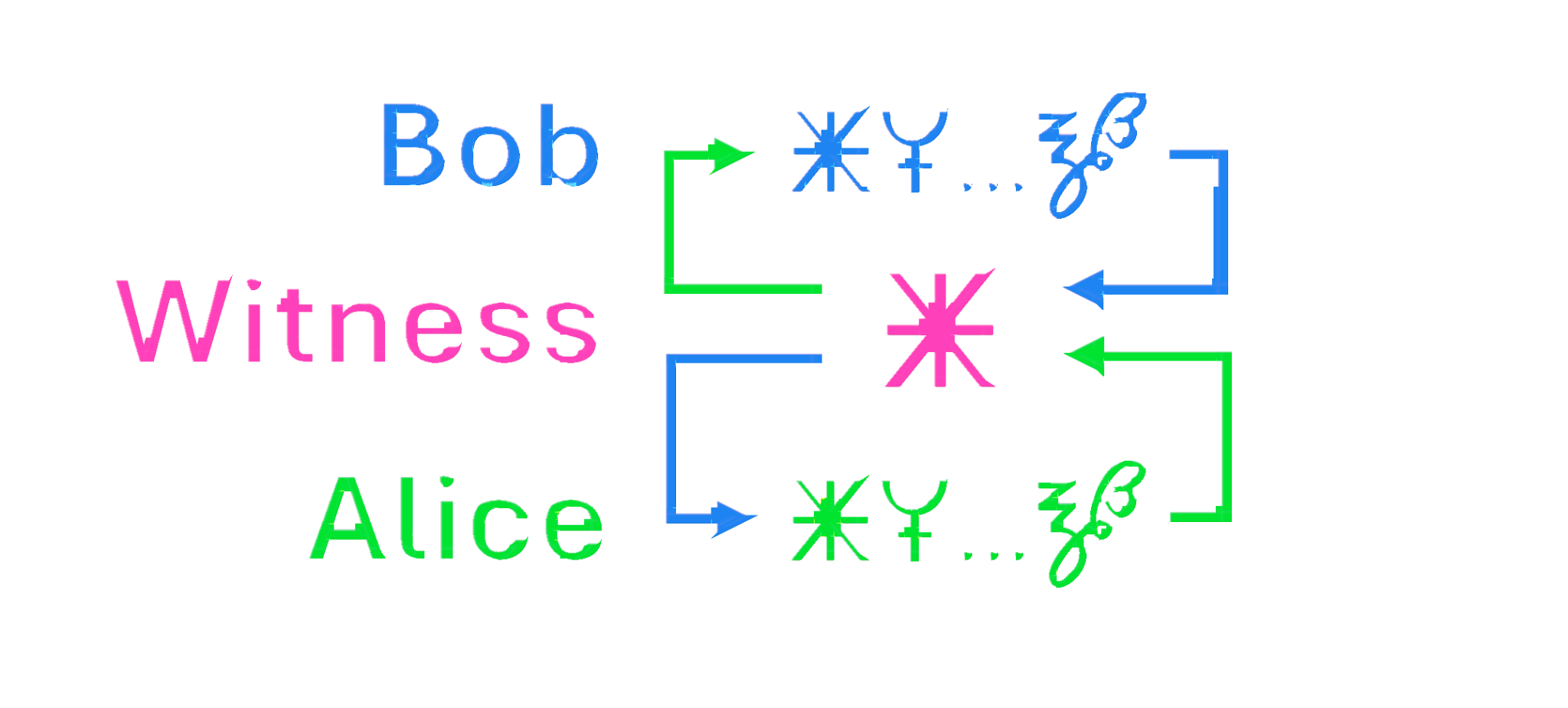
Bob and Alice each self-witness before consenting and looping back; the Witness role in the center confirms exchange-state, consent-state, delivery, openability, and any consensual revelation.
The Witness
In Abracadabracadoo, the Witness is a protocol role, not a judge. It helps transmit keys and proofs, confirms that a message was delivered, confirms that the recipient could open what was meant for them, and retains only the proofs or logs intentionally exposed through the consensual back-and-forth.
The Witness also witnesses consent-state. Every ordinary cycle carries implicit consent to continue the context. Either party may also request that a signed message be revealed in clear text to the Witness; that revelation then becomes its own loop, followed by another consent cycle showing whether both parties remain in consent after the revelation.
Delivery/openability proofs, signed receipts, timestamps, loop metadata, consent-state records, exposed logs, revocations, and any clear-text revelation that entered the Witness loop by consent.
If both parties delete their keys and messages, nothing intelligible remains. The Witness may retain evidence that an exchange and consent-state existed, but not the living relationship or any unexposed content.
The collapse condition
This is the relationship equivalent of the initial yesatom 🜁. First there is presence. Then each inside loop moves witness 🜹, consent 🝁, loop 🝳, and returns the other way. The Witness role can confirm delivery, openability, consent-state, and any consensual revelation, but the whole thing is built on the premise that a relationship is not permanent just because a system saw it once.
When the participants preserve keys, messages, witness proofs, consent-state, and renewed loops, trust can persist, renew, and grow across time.
When the participants collapse the edge together, the system should not smuggle the relationship back into permanence through a username, account, institutional registry, or witness archive.
From philosophy to implementation
Protocol
Nested loops, witnessed exchange, consent-state, scoped content revelation, revocation, and consent-aware relationship modeling for virtually any shape of trust.
Implementation
A warm, local-first implementation for HumanKey-style trust: create local labels, open paths, complete loops, and keep relationship trust close to the people using it.
Consentocracy
Not equal in power. Not equal in capacity. Not equal in role. Equal at the place where relation begins: the place where yes can be given, no can survive, scope can be named, and trust can be earned without becoming ownership.